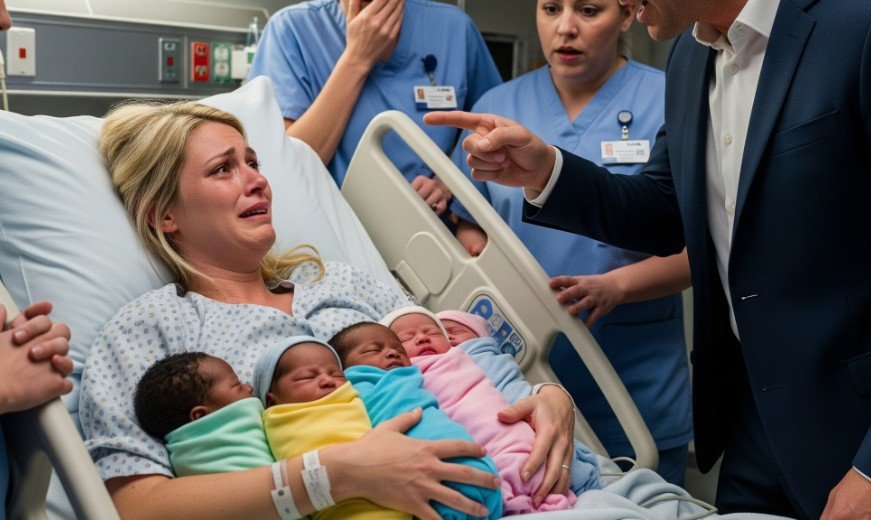
“When the babies were born, a heavy silence fell over the room, not of admiration, but of suspicion.”
In 1995, Anna Williams, exhausted, lay in a hospital bed, her body trembling after hours of labor. In her arms lay five newborns, wrapped in pastel blankets. The quintuplets were rare enough to elicit whispers among the nurses, but what truly silenced the room was their appearance. Their skin was darker, their features didn’t fit what was expected of a blonde woman and her white partner, Richard Hale.
Richard burst into the room, his face pale but his eyes burning with anger. He looked at the children, then at Anna. “What is this?” “Don’t tell me they’re mine.”
Weak and terrified, Anna whispered, “They’re yours, Richard. I swear.”
But Richard refused to believe her. “You’ve dishonored me. You’ve ruined everything.” A few hours later, he left the hospital, abandoning Anna and the children.
From that moment on, Anna’s life was turned upside down. In this small town where gossip spread like wildfire, she became “the woman with the black quintuplets.” Strangers whispered insults in the supermarket aisles. Landlords refused to rent her an apartment because they saw five toddlers clinging to her skirt. Her friends disappeared, refusing to support her.
Yet Anna refused to give in. She worked multiple jobs—cleaning housekeeper, waitress, seamstress—to feed her family. Every morning, she walked her children to school, their five little hands clasped tightly in hers. At parent-teacher meetings, she remained alone, enduring the sympathetic glances and disapproving whispers.
Her children—David, Naomi, Grace, Lydia, and Ruth—each developed their own distinct personalities. David, the eldest and only boy, drew cars and dreamed of building them someday. Naomi, spirited and outspoken, tolerated no insults toward her siblings. Grace, the dreamer, filled the house with songs and poems. Lydia was gifted in mathematics, ambitious from a young age. And Ruth, the youngest, stayed close to Anna, shy and reserved, often holding her mother’s hand as if the world could take it away.
But as unique as they were, society saw them only as the “quintuplets with the white mother.” The weight of Richard’s abandonment weighed heavily on them. And although Anna never revealed the whole story, she kept his last words in her mind for decades: Don’t lie to me.
Raising five children alone was a long and arduous task. Anna never remarried, never relied on anyone but herself. At night, she stayed awake, haunted by Richard’s betrayal, but determined that her children would never feel unwanted.
When David was ten, he asked the question she dreaded. “Why does Daddy hate us?” Anna knelt beside him, wiping away her tears. “Because he doesn’t understand love, David. It’s his failure, not yours.”
Her words shaped them. Despite the bullying and taunting, the quintuplets grew into resilient teenagers. Naomi defied authority, always ready to defend her siblings. Grace sang at school events, her voice moving audiences to tears. Lydia brought home math competition results and was already talking about starting her own business. Ruth devoted herself wholeheartedly to painting. As for David, despite occasional moments of resentment, he bore the burden of being the “head of the family” and often worked multiple jobs to support his family.