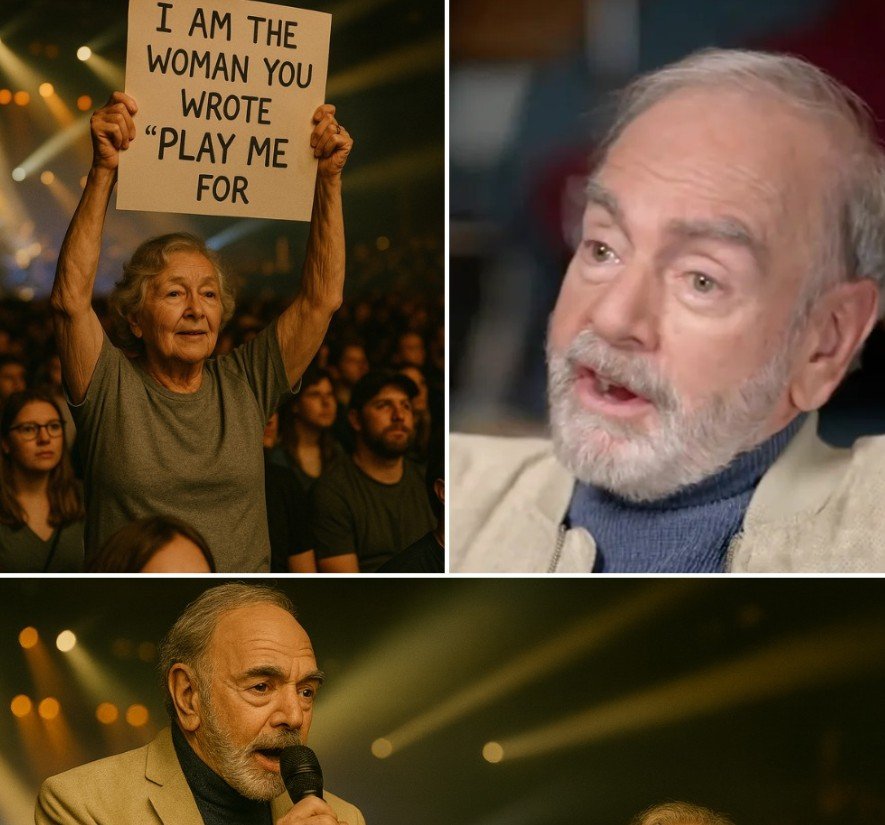
Chicago, August 8, 2025. The crowd came expecting a night of nostalgia, a victory lap for Neil Diamond’s Songs of a Lifetime tour. The setlist had already been pure magic — Cracklin’ Rosie, Hello Again, Love on the Rocks. But as the house lights dimmed for what everyone assumed would be the encore, Neil stepped back onto the stage alone.
No band, no fanfare. Just him, his guitar… and something clutched in his hand. A small, yellowed letter, edges frayed by half a century. His voice, low and trembling, carried across the silence.
“I’ve had this for fifty-two years,” he said. “She left it on my table the night she walked away. I never answered her… but I never let it go.”
He unfolded the paper slowly, as if afraid it might crumble in his fingers, and read a few lines aloud. Words of gratitude. Words of regret. Words that sounded less like goodbye and more like a promise left hanging in the air. The arena was so quiet that the faint crackle of the page seemed louder than the thousands holding their breath.
Then came the first chords of Play Me. The mystery that had haunted fans since 1972 — who was she? the muse behind his most intimate ballad — was finally being whispered into the open.
And that’s when the impossible happened.
In the sixth row, a silver-haired woman in a pale blue dress rose to her feet. In her trembling hands, a hand-lettered sign:
“I am the woman you wrote Play Me for.”
The world seemed to stop. Neil’s strumming hand froze mid-air. The audience gasped, twisting in their seats to see her. For a heartbeat, even the lights felt still. Then came that smile — slow, incredulous, a smile that held fifty years of recognition.
Neil set his guitar aside and walked toward the edge of the stage. Security stepped aside without a word as she approached, shaking, eyes brimming with tears. When she reached him, he simply extended his hand. Their fingers touched, and suddenly, it was as if time itself had folded — two lives colliding again under the glare of a thousand lights.
“I kept the letter,” Neil said, voice breaking. “Every word. Every day.”
The roar that followed wasn’t the wild cheer of an encore — it was softer, reverent, like the sound of an entire arena holding its breath and letting it out all at once.
Then, with a gentle nod, he handed her a microphone. “Sing it with me.”
At first, she shook her head, shy and overwhelmed. But Neil’s insistence was gentle, steady, impossible to refuse. Together, they began:
“You are the sun… I am the moon…”
Her voice was fragile, uncertain — until Neil’s wrapped around it like a shield. In seconds, their harmony filled the space, delicate and raw, more haunting than the original recording.
When the final chorus came, Neil stepped back, motioning for her to take it alone. And with trembling courage, she did:
“Song she sang to me…”
The arena erupted. Thousands of voices shouting, crying, applauding — but on stage, it was just the two of them, holding on, as if the world outside no longer existed.
As the last notes faded, Neil pulled her into an embrace that seemed to close a circle left open for half a century. He whispered into the microphone:
“You gave me a story that lasted my whole life. Tonight, I finally got to finish it with you.”
The band emerged softly in the background, reprising Play Me as the two walked off the stage together. Fans wiped their eyes, strangers hugged strangers, and for one unforgettable night in Chicago, a fifty-two-year-old mystery wasn’t solved with words — it was answered in song.